Simple language makes texts understandable for everyone. It helps people with neurodiversity, learning disabilities or poor German language skills. Users with intellectual disabilities also benefit from it.
It makes sense for companies to write as simply as possible. Whether on websites, apps or social media – they reach more people with clear words. And that’s what this article is about.
We’ll show you:
- Why plain language is important
- Which rules it follows
- How you write simply and understandably
- What the differences are to plain language
You will learn how to turn complicated texts into understandable messages. Without any technical jargon or nested sentences.
The goal: to create content that everyone understands. From teenagers to grandmothers, from professionals to beginners.
Why is plain language important?
Plain language enables people with reading difficulties, little knowledge of German or cognitive impairments to access information.
There are over 6 million people with reading difficulties in Germany. Plain language creates real inclusion by breaking down barriers and allowing them to participate in digital life.
Simple language also improves the overall user experience. Who likes struggling through illegible texts? Simple language leads to fewer misunderstandings, saves time on explanations and reduces support requests.
In addition, clearly structured, understandable content improves the SEO ranking. Simple language therefore also makes economic sense.
DIN standards for plain language
DIN standards for plain language have been in place since 2024. They make it easier for writers to write clearly. Two important standards:
DIN ISO 24495-1: Four basic rules
This standard has defined the principles and guidelines for plain language since March 2024. It is based on four core principles:
- Relevance: Readers receive the information they need.
- Findability: Important information is easy to find.
- Comprehensibility: The content is easy to understand.
- Applicability: The information can be used without any problems.
DIN ISO DIN 8581-1: Concrete tips for German
Since May 2024, this standard has specified the use of plain language specifically for German. It provides practical advice on:
- Text level: content, style and structure
- Sentence level: length, structure and tenses
- Word level: length and familiarity of words
- Design: Typography and hyphenation
These rules are worth their weight in gold for authorities, companies and anyone who has to explain complicated topics. They save time and stress because people understand what is at stake more quickly.
By the way: DIN experts are already working on rules for legalese and scientific texts. You can take part in the development if you like.
Basic principles of plain language
Texts in plain language are well structured. You use meaningful headings that clearly state the content. Paragraphs are short and only deal with one idea at a time. Lists help to present information clearly. This structure makes it easier to grasp the text and find relevant content quickly.
- Use simple words and short sentences. Use everyday words that many people know. Explain difficult terms if you have to use them. Keep sentences short, preferably under 15 words. A sentence should only contain one statement. Avoid nested sentences and complicated grammar.
- Use active verbs instead of passive constructions. Instead of “The ball was thrown by Tom”, write “Tom threw the ball”. This makes the text lively and understandable. Clearly state who is doing something.
- Images and graphics can complement texts well. They help you to grasp key messages more quickly. Choose simple, clear illustrations. Pictograms are well suited for recurring topics. Infographics can make complex relationships easier to understand
Further rules for understandable German
- Avoid foreign words and anglicisms. If you need it, explain it.
- Use concrete examples to illustrate abstract ideas.
- Address the reader directly, use “you” or “you”.
- Avoid idioms and proverbs that not everyone knows.
- Write numbers as digits, not as words (12 instead of twelve).
- Use bullet points for lists to structure information clearly.
- Avoid abbreviations or explain them the first time you use them.
- Place important information at the beginning of the text or paragraph.
- Use a legible font and a sufficient font size.
- Make sure there is enough contrast between the text and the background.
Before and after: Texts with and without plain language
The best way to get started with simple language is with a few examples. We show you how to turn complicated language into simple language.
Example 1: Product description
- Before: “Our innovative latest-generation multifunctional device offers you a wide range of options for efficient document processing and management, including high-resolution scanning, copying and printing in color as well as fax functionality.”
- After: “Our new device can do a lot. It scans documents in high quality, makes color copies, prints in color and can fax. You can manage your documents quickly and easily with this device.”
Example 2: Authority text
- Previously: “To apply for an ID card, the applicant must appear in person and present the completed application form as well as a biometric photo and the previous ID document.”
- After: “You want to apply for a new ID card? Here’s how: Fill out the application form. Take the completed application to the Citizens’ Registration Office. Bring a biometric passport photo and your old ID with you.”
Simple & easy language in implementation
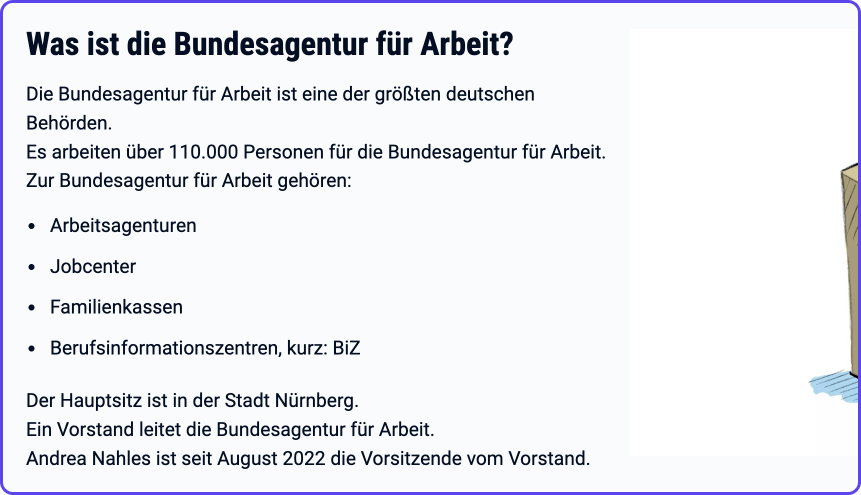
The arbeitsagentur.de website offers many texts in plain language. It uses a clear menu structure and highlights important information. Explanatory videos complement the texts in a meaningful way. Here we can see how different media can be combined to convey content in an understandable way.
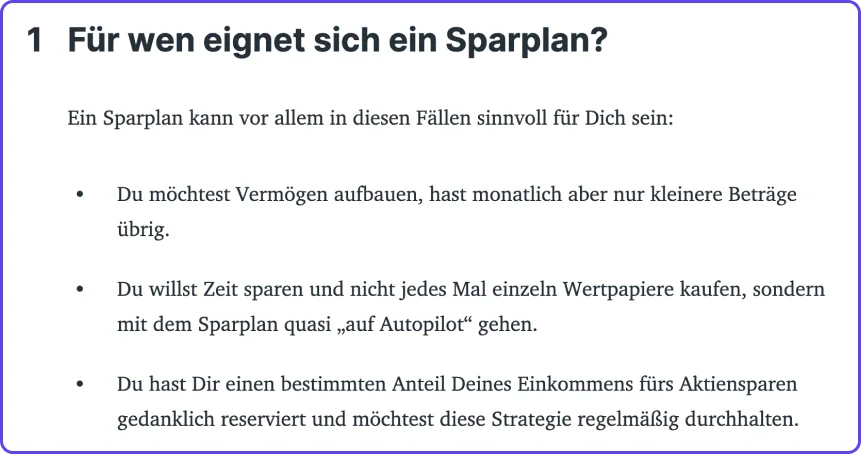
The Finanztip online portal is a good example of simple language in the financial sector. They make complex financial topics understandable without oversimplifying.
Plain language & simple language: the differences
There are differences between plain and simple language. Easy language follows strict rules. For example: one sentence, one statement. The aim: to simplify as much as possible. It is particularly useful for people with intellectual disabilities, dementia or the deaf.
For a long time, plain language did not follow any standardized rules. It adapts flexibly to the reader. Sometimes it is closer to everyday language, sometimes it is more simplified. The aim: everyone should be able to understand the text. Technical jargon and difficult words are taboo. However, the above-mentioned DIN standards for plain language have been in place since 2024.
Plain language is for people with neurodiversity, learning disabilities, German learners or young people. People with mild intellectual disabilities also find plain language understandable.
Simple language: What are you waiting for?
Now it’s your turn! Start by taking a critical look at your own texts. Where can you simplify? Where could you be clearer? Start with small steps – revise a paragraph, then a page. Over time, you’ll develop a feel for how to express complex content simply.
Remember: Simple language is not a sign of simplification, but of clarity and respect for your readers. It helps you get your message across more effectively and reach more people. With every text you simplify, you contribute to a more inclusive digital world. Start today – your readers will thank you!