164 slides, 70+ hours of preparation, a bulging bag of pretzels and enough sparkling water to drown a small village – it was all in our 4-hour inspirational workshop for the Greens.
Just a moment. The Greens? Exactly! The Greens’ parliamentary group in the Bundestag became aware of us through a full-page interview in the Tagesspiegel. They then booked a workshop with us to gather inspiration for the website of the future.
These were the topics of the workshop, which we summarize in this article:
- Design & sustainability
- UX & Accessibility
- Technology
- SEO
- Artificial intelligence
- Social media (not in the article)
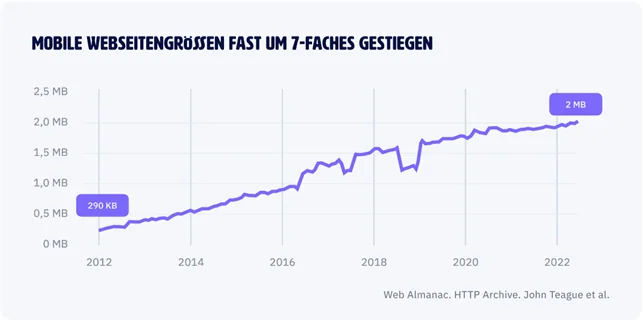
Sustainability: Mobile website sizes have increased almost sevenfold since 2012
When ambitious web designers give free rein to their imagination, only one thing is certain: everything has to move! Cool videos! Animations! 3D! The users have to look like this and nothing else:
We feel – if there wasn’t a small problem: websites are getting heavier and heavier. Overweight, so to speak. Mobile website sizes have increased almost sevenfold since 2012.
This immediately leads to a few problems:
- The power consumption of the Internet increases invisibly. Researchers expect it to increase by at least 50% by 2030.
- Complex websites require fast devices. This increases the pressure to buy new appliances – and the production of new appliances in particular causes many emissions during the appliance life cycle.
- Users with slow internet connections can be excluded. Long loading times are a knock-out criterion for the use of websites.
Sustainability: The website of the future is ethical
Technology for technology’s sake? This credo has had its day. Modern websites think about people and the environment. They are:
- Energy-saving: Optimized websites save energy. How exactly? This page explains.
- User-centered: It’s not the designer’s ego that counts, but what the users want and need.
- Accessible: Intuitive, clear and self-explanatory – this is how a website should be structured.
- Inclusive: Whether you have a physical disability or not – everyone should be able to use the website. For example, with optimizations for screen readers or keyboard use.
Design: Maximum vs. sustainability
To simplify the whole process, we have divided websites into three categories: 1) maximum feasibility, 2) aesthetics & function and 3) sustainability first.
Maximum of what is possible
These pages are larger than 50 MB and contain, for example
- many videos (with autoplay)
- uncompressed images
- elaborate animations
- 3D elements

Aesthetics & function
These pages are 5 – 10 MB and contain for example:
- Glass Morphism
- Compressed images (JPG)
- Videos (without autoplay)
- Many visual elementsAesthetics & function
Sustainability First
These pages are 0.1 – 2 MB and contain for example:
- prominent typography (e.g. instead of images)
- little to no videos
- SVGs instead of images
- Images only where appropriate

UX: Thinking from the user’s perspective
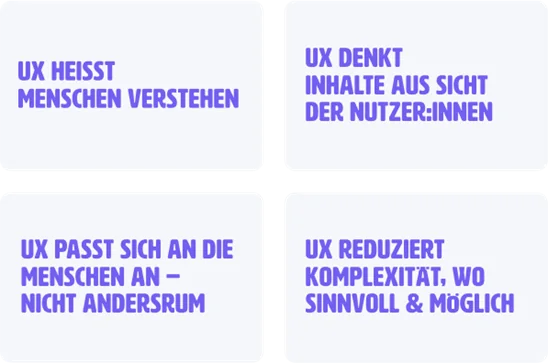
Good UX? Think like the users: What do they want to know? What do they need to understand?
Everything is easier in threes – so here’s our three-point plan for the best UX:
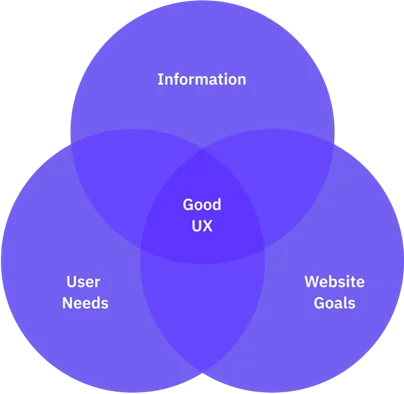
Information:
- What kind of information and content can (and do I want to) offer?
- How do I structure my offer so that it is accessible & efficient?
User Needs:
- Is this really interesting for my site visitors?
- Does my offer help to satisfy your search interest?
Business Goals:
- What are the overarching goals of my brand / organization?
- What role does the website play in this, what should it achieve?
Technology, SEO & AI
The next topic blocks are streamlined. There was 20 minutes of information on each topic in the workshop.
Technology: Small websites are the trump card
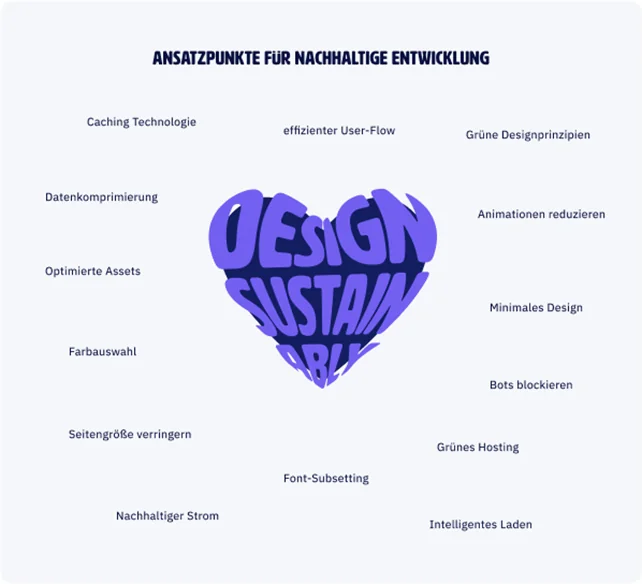
It has to be small, the sustainable website! Because less is more: videos eat up memory and are often not even necessary. Images also need a lot of memory. Rule: Media only if they are really useful.
SEO: past, present and future
Formerly: Keyword stuffing.
Keyword density and diversity has long been the most important metric for the ranking of a page.
- Focus on keyword spamming
- Questionable content of the texts
- not very user-friendly
Today: Complexalgorithms.
Today, Google is smarter – and evaluates the usefulness of a page using many variables.
- Helpful content & good UX are rewarded
- Keywords have become less important
- the performance of pages is becoming more important
Tomorrow: Merging with AI.
Even Google is puzzling over AI’s future in search. Possible scenarios could be:
- Integration of search results in AI chats
- even more focus on search intent instead of keywords used
- Monetization of AI chatbots, e.g. through “sponsored” answers
AI: ChatGPT and Midjourney are top dogs
Nowadays, there is an AI tool for every fart. But not all of them are sophisticated enough to be worth using. ChatGPT and Midjourney are an exception. These two AI helpers are already maximizing efficiency and productivity.
Example: ChatGPT can simplify texts
Old:
As a professional network and innovative do tank, Circularity e.V. is helping to shape the German circular economy.
Our network focuses on linking experts from all areas for joint learning and exchange and thus offers a platform for informed, interdisciplinary dialog at a national level.
Transcribed by ChatGPT (for easy understanding):
The association Circularity e.V. helps to reuse things in Germany again and again instead of throwing them away. People from many different professions work together in our group.
We learn from each other and exchange ideas. In this way, we create a place where everyone can have a good conversation and learn from each other, regardless of their background.
AI causes up to 2900x less CO2 emissions
Who causes more emissions: Humans or AI? A group of renowned university professors wanted to find out exactly that.
The surprise: While ChatGPT is writing a page of text, it emits 130 to 1500 times less CO2 than a human writer.
And Midjourney? When drawing an illustration, it produces 310 to 2900 times less CO2 than a classic illustrator.
These figures are based on the everyday CO2 footprint of a person – added to the CO2 emissions of a computer during working hours.
Want to read more on that? You can view the research paper here.
Conclusion: Ethics as a guide to the future
At the end of the workshop it was clear: it’s not just about looks. More important: How efficient is the website? How accessible? And is it ethical?
Ethics must also be a top priority behind the scenes of the web – be it SEO or AI. Acting digitally must include ethical behavior. We wanted to make this clear with the workshop for the Greens.
Design, tech and ethics are growing together – for a better digital future for us all.